
When Plans Change: Surgical Implantation of a Transcatheter Pulmonary Valve in Hypoplastic Left Heart Syndrome
Every surgical plan for a neonate with hypoplastic left heart syndrome (HLHS) must account for the possibility of unexpected findings. This case demonstrates how our multidisciplinary team adapted when the original surgical plan was no longer feasible. By redesigning our approach, we preserved the patient’s future treatment options.
A Surgical Plan That Changed in the OR
A term neonate arrived at Phoenix Children’s on day of life 0 with worsening hypotension, metabolic acidosis, acute kidney injury and increasing inotropic support. In addition to HLHS with mitral stenosis and aortic atresia, the patient also showed signs of early pulmonary overcirculation. As a result, we placed the patient on mechanical ventilation and used pulmonary blood flow restrictors as a temporizing strategy toward the Norwood procedure.
After the flow restrictor implant, echocardiography showed new-onset pulmonary regurgitation and a 3-mm defect in either the posterior or the left leaflet of the pulmonary valve. The patient’s condition worsened, and they required venoarterial extracorporeal membrane oxygenation (VA-ECMO). After multidisciplinary discussion, we decided to attempt a valve repair.
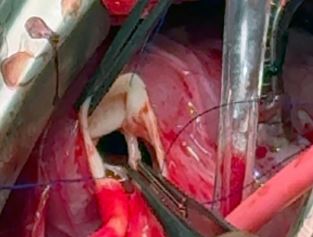
What we found intraoperatively changed the plan entirely: a left pulmonic cusp free margin avulsion that was irreparable. The tissue was too friable for suture repair. We needed a different approach.
A New Approach: Surgically Placing a Transcatheter Valve
When the patient was 10 days old, we opted to replace the pulmonary valve with a Melody transcatheter valve (Medtronic). We had previous experience placing this tool in other positions. However, this was the first known attempt at implanting the valve in the pulmonary position in a neonate before Stage I palliation.
To shorten a 22-mm Melody valve, our surgeons folded the metallic triangular edges outward, crimped it by hand over a 14-mm balloon and positioned it across the pulmonary annulus. We were careful to preserve enough pulmonary artery tissue for closure, avoid obstruction of the right ventricular outflow tract and prevent coronary or aortic root compression through overdilation. Three interrupted sutures secured the distal end. Cardiopulmonary bypass time was 78 minutes with an aortic cross-clamp time of 50 minutes. Daniel Velez, MD, was the primary surgeon.
Postoperative echocardiography showed mildly decreased right ventricular function with no evidence of stenosis, regurgitation, paravalvular leaks or outflow tract obstruction. We successfully decannulated our patient from VA-ECMO.
A Bridge to Decision-Making, Not Definitive Palliation
For referring physicians, the distinction matters. This was not a shortcut to Stage I palliation. The Melody valve was a bridge to decision-making, stabilizing a critically ill neonate while our multidisciplinary team assessed whether the patient’s overall condition could support a long-term treatment pathway.
The only viable long-term option, if the patient’s extracardiac conditions were not prohibitive, was to list for transplant. The hybrid approach, paired with valve replacement, allowed the team to preserve that option while the bigger picture came into focus.
The patient subsequently underwent successful patent ductus arteriosus stent placement as palliation. Cardiac catheterization confirmed a well-seated valve with no stenosis or regurgitation.
A Rare Scenario With a Framework That Can Help
Data from the Pediatric Cardiac Care Consortium underscore how rare this scenario is: Of 3,807 patients with single-ventricle physiology, only 12 had undergone semilunar valve surgical or transcatheter replacement. None occurred before Stage I palliation. None was performed via an open surgical approach.
When pulmonary valve dysfunction occurs before Stage I palliation in a patient with HLHS, conventional options are limited. Patient size, tissue friability and the futility of repair in some cases can eliminate standard pathways. This case demonstrates that a surgically placed transcatheter valve may be a technically feasible alternative in that setting, helping to stabilize the patient while preserving future treatment options.
Considering the Risks
This approach was a short-term solution, not a definitive repair. Clinicians weighing a similar strategy should account for several risks. They should consider outflow tract obstruction from proximal valve placement and coronary compression or aortic root compromise from overdilation. They should also assess the limitations of using a transcatheter valve for open surgical placement in this anatomy. Underlying single-ventricle physiology further limits the patient’s tolerance for hemodynamic compromise.
How to Refer
Phoenix Children’s Center for Heart Care offers comprehensive management for neonates born with HLHS, including the multidisciplinary infrastructure needed to respond when surgical plans change in the OR.
If you care for a patient with suspected or confirmed HLHS, early referral gives our team more time to evaluate the patient and plan for complex care. When possible, refer during the prenatal period or as soon as possible after diagnosis. To refer a patient to Phoenix Children’s Center for Heart Care, call 602-933-KIDS (5437) or submit an online referral.
Multidisciplinary Expertise When Plans Change
Managing a case of this complexity requires the full depth of a dedicated pediatric cardiac program. At Phoenix Children’s, that included cardiac surgery, interventional cardiology, cardiac imaging, the cardiac intensive care unit, the ECMO team and the cardiac catheterization laboratory. Together, these teams adapted to an unexpected surgical finding while preserving future treatment options.
About the Author
VMohamad Alaeddine, MD
Mohamad Alaeddine, MD, is co-director, Center for Heart Care, and a pediatric cardiothoracic surgeon at Phoenix Children’s. He has extensive training in the surgical treatment of cardiac conditions that affect infants, children and adolescents. His areas of expertise include congenital cardiac surgery for all patient ages, heart transplantation and the implantation of ventricular assist devices.
Source
Quiñones-Carrasquillo, S., Giammarino, T. M., Alaeddine, M., Kisamori, E., & Velez, D. A. (2026). When plans change: Surgical implantation of a transcatheter pulmonary valve in hypoplastic left heart syndrome. JTCVS Techniques, 36, 102198. https://doi.org/10.1016/j.xjtc.2026.102198