
Search Videos and More
Showing 1 - 9 of 9 results
 Video
Video
Fetal Anomalies & Perinatal Mental Health Implications for Practice
Strengths-based, trauma-informed care is key to the clinical approach our team at Phoenix Children’s uses for the unique aspects of care for expectant parents and infants. Video
Video
Overview of severe BPD (sBPD)
What is bronchopulmonary dysplasia? Discussion of the modes of support, diagnostic criteria, support, wide-reaching impact, prevalence, unique physiology and lifelong risk factors. Video
Video
Transitions of Care and Collaborations: What Can We Learn From Each Other?
NICU to PICU transitions: Ongoing patient needs, opportunities for standardization and optimal transition of patients from neonatal to ex-preemie care. Video
Video
Patient and Family Perspective of Care – Assessing the Impact of Our Care
Dr. Deborah Tom moderated a panel discussion among parents of infants with BPD to explore how providers can better assess the needs of individual families and work within care teams to improve care delivery.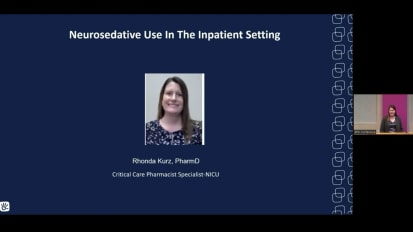 Video
Video
Neuro-Sedative Use in the Inpatient Setting
Pharmacist Rhonda Kurz spoke on the variability in use of medications for BPD and variability of individual responses to medications. Video
Video
Emerging Therapies for Prevention and Treatment of BPD
Dr. Vlad Kalinichenko considered the use of novel pharmacologic treatments that may prevent BPD and/or more effectively treat the manifestations of BPD. Video
Video
Systemic Corticosteroids – Timing is Everything
Dr. Amy Brown presented on how the timing of use of systemic corticosteroids may prevent BPD and/or more effectively treat the manifestations of BPD. Video
Video
Therapies for BPD-Associated Pulmonary Hypertension – What Do We Know Now?
Dr. Kevin Engelhardt presented on therapy options for BPD-associated pulmonary hypertension. Video
Video
Inhaled Respiratory Medications - “Helpful, Harmful, or Just a Burden?”
Dr. Rajeev Bhatia assessed the risks and benefits of commonly used medications for infants with BPD, as well as at the individual level for the specific patient.