
Search Videos and More
 Video
Video
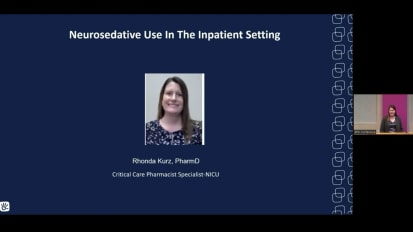
Neuro-Sedative Use in the Inpatient Setting
Pharmacist Rhonda Kurz spoke on the variability in use of medications for BPD and variability of individual responses to medications. Video
Video
Emerging Therapies for Prevention and Treatment of BPD
Dr. Vlad Kalinichenko considered the use of novel pharmacologic treatments that may prevent BPD and/or more effectively treat the manifestations of BPD.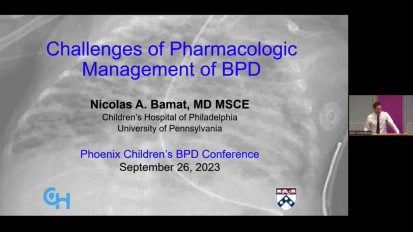 Video
Video
Challenges of Pharmacologic Management of BPD and Research Highlights Relating to Diuretic Usage
Dr. Nicolas Bamat, assistant professor of Pediatrics in the Division of Neonatology & Center for Clinical Effectiveness at Children’s Hospital of Philadelphia, was the keynote speaker, exploring the evolution of pharmacologic management of BPD, and explaining how to apply the evidence for medication use to support local care guidelines and practice Video
Video
Systemic Corticosteroids – Timing is Everything
Dr. Amy Brown presented on how the timing of use of systemic corticosteroids may prevent BPD and/or more effectively treat the manifestations of BPD. Video
Video
Therapies for BPD-Associated Pulmonary Hypertension – What Do We Know Now?
Dr. Kevin Engelhardt presented on therapy options for BPD-associated pulmonary hypertension. Video
Video
Inhaled Respiratory Medications - “Helpful, Harmful, or Just a Burden?”
Dr. Rajeev Bhatia assessed the risks and benefits of commonly used medications for infants with BPD, as well as at the individual level for the specific patient. Document
Accuracy of Multimodality Fetal Imaging
Ultrasonography (US) is the first-line diagnostic tool used to assess fetal musculoskeletal (MSK) anomalies. Associated anomalies in other organ systems may benefit from evaluation via Magnetic Resonance Imaging (MRI). News
News
BPD: Progress Through Teamwork and the National BPD Collaborative
Bronchopulmonary dysplasia (BPD) is the most common respiratory complication of prematurity, affecting an estimated 10,000 to 15,000 babies in the U.S. annually - about 33 percent of babies born with a birthweight of less than 1,000 grams.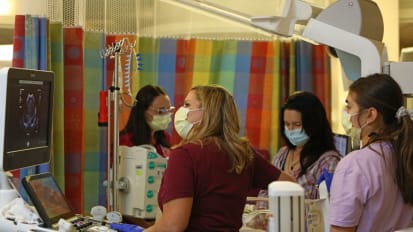 News
News
Retrospective Research Confirms that Complex Pediatric Patients with CDH Thrive with Multidisciplinary Approach to Care
CDH Program at Phoenix Children's Reveals the Positive Power of Teamwork. News
News
Phoenix Children's Building New NICU
Phoenix Children’s, one of the nation’s fastest-growing pediatric health systems, today announced the construction of a new 44,000-square-foot neonatal intensive care unit (NICU), slated to open next year at Phoenix Children’s Hospital — Thomas Campus. News
News
Perinatal Palliative Care Team Offers Expectant Families an Expert, Earnest Layer of Guidance and Support
After a recent expansion of its pediatric palliative care program, Phoenix Children’s now offers customized, coordinated care to expectant parents who learn their baby has a serious congenital anomaly. Video
Video
Congenital Diaphragmatic Hernias
Congenital diaphragmatic hernia occurs in approximately every 1-in-5,000 births. Dr. Mark Molitor explores the evolution of how we treat congenital diaphragmatic hernias and why this often includes ECMO.