
Search Videos and More
 News
News
Phoenix Children's Research Institute Study Identifies FOXF1 Enhancers Involved in Rare Lung Disease
The FOXF1 protein is critically important in pulmonary vascular development, specifically responsible for the extension and branching of airways and blood vessels in the developing lung. Video
Video
Therapies for BPD-Associated Pulmonary Hypertension – What Do We Know Now?
Dr. Kevin Engelhardt presented on therapy options for BPD-associated pulmonary hypertension. News
News
Renowned Fetal Imaging Team Helps Improve Outcomes Among Babies with Congenital Defects
Thanks to the sophisticated technology and skilled fetal imaging specialists at Phoenix Children’s, more high-risk infants have a chance to live long, healthy lives. Document
Risk Factors for Adverse Outcomes Following Surgical Repair of Simple Coarctation in Early Infancy: A Ten-Year Single Center Review
Coarctation of the aorta is a frequently diagnosed congenital heart defect often requiring surgical repair in early infancy. News
News
Prenatal Detection of Congenital Heart Disease: Recent Experience Across the State of Arizona
This was a retrospective chart review using the Society of Thoracic Surgeons and Phoenix Children's Fetal Cardiology databases. Video
Video
Emerging Therapies for Prevention and Treatment of BPD
Dr. Vlad Kalinichenko considered the use of novel pharmacologic treatments that may prevent BPD and/or more effectively treat the manifestations of BPD. Symposium
2023 Perspectives in Bronchopulmonary Dysplasia – Pharmacology of BPD
In September 2023, Phoenix Children’s Center for Fetal and Neonatal Care hosted its annual Bronchopulmonary Dysplasia (BPD) Conference. News
News
Perinatal Palliative Care Team Offers Expectant Families an Expert, Earnest Layer of Guidance and Support
After a recent expansion of its pediatric palliative care program, Phoenix Children’s now offers customized, coordinated care to expectant parents who learn their baby has a serious congenital anomaly.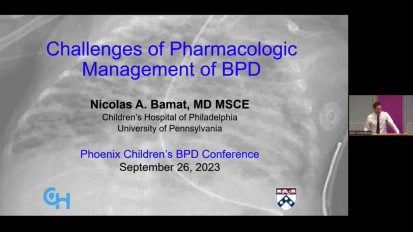 Video
Video
Challenges of Pharmacologic Management of BPD and Research Highlights Relating to Diuretic Usage
Dr. Nicolas Bamat, assistant professor of Pediatrics in the Division of Neonatology & Center for Clinical Effectiveness at Children’s Hospital of Philadelphia, was the keynote speaker, exploring the evolution of pharmacologic management of BPD, and explaining how to apply the evidence for medication use to support local care guidelines and practiceStandardized Small Baby Care Implemented by Phoenix Children’s Neonatologists Improves Outcomes
In response to the growing number of extremely preterm infants born in Arizona, Phoenix Children’s and Dignity Health St. Joseph’s Hospital and Medical Center together created a protocol for small baby care to focus on improving outcomes among this particularly vulnerable population. News
News
Phoenix Children’s Researcher Awarded $3 Million Grant to Develop New Therapy for Lung Diseases in Premature Babies
An internationally renowned research scientist at the Phoenix Children’s Research Institute at the University of Arizona College of Medicine – Phoenix has been awarded a multimillion-dollar grant from the National Institutes of Health (NIH) to develop new treatment methods for lung disease in premature infants. Video
Video
Congenital Heart Disease: Helping Parents and Providers
Congenital heart disease is a common birth defect. Ericka Scheller McLaughlin, DO, pediatric and fetal cardiologist, discusses what parents can expect and how Phoenix Children’s can help.